Heat pump quotes: how to compare them (and the red flags)
How to compare heat pump quotes: what a proper quote names, why a price before anyone measures is a red flag, and a real Ashford example.
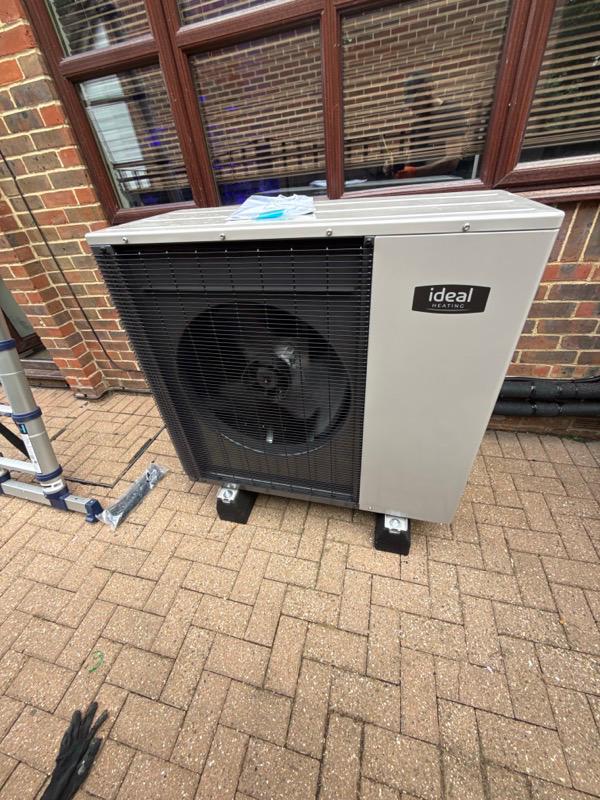
The best way to compare heat pump quotes is to ignore the total for a minute and check what each one actually includes, and whether anyone measured your house before they priced it. A good heat pump quote names the unit, says what it’s sized to, and lists every radiator, cylinder and bit of pipework it changes. If it can’t do that, it’s a guess with a number on the bottom.
When people show me quotes that don’t match, the problem usually isn’t that one installer is a crook and another’s a saint. It’s that the quotes aren’t describing the same job, so the totals can’t be compared at all.
Three quotes, one house in Ashford
I quoted a heat pump job in Ashford where the homeowner already had three other quotes in hand. They ran from £8,200 to £14,900, with the third one in between.
Same house. Same family. Same winter to get through. And a gap between the lowest and the highest that would buy you a decent second-hand car.
Here’s the thing. None of those numbers on their own tells you who’s right. The cheap one might be a fair price for a simple swap. The dear one might include work the others quietly left out. Or the cheap one might have skipped the measuring and the dear one might be padded. You can’t tell from the total. You can only tell from what’s written underneath it.
For a bit of context, a fully installed air source heat pump from me is usually £8,500 to £11,000 before the grant. So the lowest of those sat a little under my usual range, and the top one was well over it. That doesn’t make any of them wrong. It just tells you where to start asking questions.
What a proper heat pump quote should name
Think of a quote like a recipe. If it just says “cake” and a price, you’ve no idea what’s going in it. You want the ingredients.
So the first thing I’d look for is the heat pump itself. Make, model and size. Not “high efficiency air source unit”. The actual model, so you can look it up yourself.
Then I’d want to know what it’s sized to. A heat pump should be sized to how much heat your house loses on a cold day. That figure should come from measuring the rooms, the walls, the windows and the insulation. If a quote gives you a unit size but can’t tell you how they got to it, ask.
Next is radiators. Heat pumps run cooler than a gas boiler, so some rooms may need bigger radiators and some won’t. A good quote says which rooms change and which stay. I’ve written more on this in do you need new radiators for a heat pump, but the short version is it should be room by room, not “replace all radiators” as a blanket line.
Then the hot water cylinder, if you need one. Plenty of homes coming off a combi will. The quote should say what size and where it’s going.
After that, the smaller bits that add up. Pipework changes, electrical work, the base or brackets for the outdoor unit, controls, and taking the old boiler away. These are the lines that go missing from cheap quotes and turn up later as extras.
And finally, the grant. If you’re eligible for the Boiler Upgrade Scheme, the quote should show the full price, the grant coming off, and what you’ll actually pay.
The red flag: a price before anyone’s measured
Here’s where I’ll say something that won’t make me popular with some of the trade. If someone gives you a firm price for a heat pump over the phone, or from a few photos, before they’ve been round to measure your house, I’d be wary.
It’s not that they’re necessarily dishonest. It’s that they can’t know. Two houses that look the same from the street can lose heat very differently. One’s had the loft done and new windows. The other’s still got single glazing in the back bedroom. Same size house, very different heat pump.
A quote without a heat loss survey behind it is either going to be too big, which costs you more up front, or too small, which costs you every winter. Neither is a good deal, however nice the number looks.
So when you’re lining quotes up, ask each installer one simple question. “How did you work out the size?” If the answer is a proper room-by-room survey, good. If the answer is “it’s a three-bed, they all need about the same”, that’s your answer too.
How to read heat pump quotes side by side
Once you’ve got the details, comparing gets much easier. I’d put them next to each other and go line by line.
Is it the same size unit? If one installer says your house needs a much bigger heat pump than another, one of them has measured it wrong, or one of them hasn’t measured it at all. Ask both how they got there.
Are the same radiators changing? If one quote replaces every radiator and another changes two, that alone can explain a big part of a price gap. Neither is automatically right. It depends what the survey found.
Is the cylinder in both? Is the electrical work in both? Is the old boiler coming out in both? You’d be surprised how often the lowest quote is low because it’s quietly missing one of these.
Then look at what happens after it’s in. Who sets it up, who shows you how to run it, and who you ring if it’s not right. A heat pump that’s set up badly can cost more to run than the boiler it replaced. I’ve seen it. Setting the flow temperature right matters more than most people think.
Once you’ve done all that, the totals start to make sense. Sometimes the dear quote turns out to be fair. Sometimes the cheap one does. Either way, you’re comparing like with like, not three different jobs that happen to share a postcode.
Don’t forget the grant in the sums
Most people comparing heat pump quotes are also counting on the Boiler Upgrade Scheme. For an air source or ground source heat pump, that’s up to £7,500 off. If your home is off the gas grid and heated by oil or LPG, it’s up to £9,000 off until 31 March 2027.
The grant is applied for by an MCS-certified installer, as the government’s own Boiler Upgrade Scheme page sets out. So it’s your installer who should be showing it on the quote.
With the standard grant of up to £7,500 off, most of my air source installs end up at £1,000 to £3,500 for the homeowner. Every quote you get should show you that sum clearly: full price, grant, what’s left. If it doesn’t, ask for it in writing.
If you’re on oil and wondering whether to switch now, I’ve covered that in more detail in heat pump grant for oil boilers. And if you’re weighing up ground source, what ground source really costs puts the numbers side by side.
Should you just go with the lowest quote?
Sometimes, yes, you should go with the lowest quote, as long as it covers the same job as the others. If it names the same kit, the same radiators, the same cylinder and the same extras as the others, and it’s from an installer who measured your house, then it’s just a good price. Take it.
The problem is that’s rarely what’s going on. Usually the low one is lower because something’s missing, and you only find out what when the work’s half done. I’d rather someone paid a bit more for a quote that tells them the whole job than paid less for one that leaves the hard bits out.
The same goes the other way. A big number isn’t proof of quality. If the highest quote can’t explain why it costs more, line by line, that’s not a premium service. That’s just a bigger number.
What I’d do if I were you
Get at least two or three quotes. Make sure every installer comes round and measures the house properly. Ask each one to put in writing the unit, the size, which radiators change, the cylinder, the extras, and the grant.
Then lay them side by side and go through them one line at a time. If something’s on one quote and not another, ring and ask. A good installer won’t mind. A bad one will get vague.
If you want to know more about how heat pumps fit Kent homes before you start, my heat pump installation page covers the basics.
And if you’re in Kent and you’ve got quotes in front of you that don’t add up, or you want one done properly from the start, give me a ring on 01622 234 233, or ask for a free quote. I’ll tell you straight what I think.